This year, user and development activity around Shape has been so intense that we would like to thank all the users for applying Shape. We also highlight some of the contributions that they have made to astrophysics.
A major new release of Shape has introduced a number of new features, a new interface and an extensive online manual.
The frontpage of the ShapeSite shows a visual summary of the papers that have been published or accepted for publication this year. It nicely shows the high level of acceptance that Shape has received by now. The type of problems that have been worked on range from morpho-kinematic models of simple to very complex planetary nebulae, CO-emission in pre-planetary nebulae, supernova remnants, the fast expansion of novae and physical scattering calculations in the Red Rectangle.
The application of Shape to the analysis of internal proper motion measurements of a planetary nebula has lead to the development of a brand new kinematic mapping technique called criss-cross mapping.
Here are a few examples of conclusions that have been drawn from some models:
Munari et al. have shown that the evolution of the H profile of the very fast nova V2672 Oph "suggests that the overall structure of the ejecta is that of a prolate system with polar blobs and an equatorial ring".
Meaburn et al. used Shape to model the very peculiar "Honeycomb" nebula and showed that its apparent structure is likely due to a fortuitous orientation of hydrodynamical instabilities of a supernova remnant.
This year has also seen the first publication based on the automatic 3D reconstruction capabilities of Shape. This result by Nakashima et al. has made it onto the cover of the Astronomical Journal.
The number of papers published or accepted in a year has risen considerably. Refereed journals have already published 6 papers and 4 are in press. The Asymmetrical Planetary Nebulae V conference in England saw 9 contributions, 5 oral and 4 posters, with Shape models and reconstructions. Further poster contributions were presented at the HST 3 meeting in Venice, Italy, and at the Eurographics conference in Sweden.
There is also an undergraduate thesis that was completed this year by Sergio González from Puebla, Mexico. He studied how non-homologous expansion of planetary nebulae changes the morphology during their evolution, taking advantage of the animation module of Shape.
Many Shape models have been produced by students for their thesis work. We hope that Shape will help many more young, and not so young, astronomers to understand what is going on in the objects that they are working on.
For the list of papers that contain results obtained with Shape see the publications page.
We wish you a happy 2011!
Nico and Wolfgang

Mostrando las entradas con la etiqueta Simulaciones y Animaciones. Mostrar todas las entradas
Mostrando las entradas con la etiqueta Simulaciones y Animaciones. Mostrar todas las entradas
diciembre 17, 2010


junio 15, 2010
Lanzamiento de Shape 2010
Dear colleagues and friends,
We are pleased to inform you that this year's version of the morpho-kinematic modeling software SHAPE will be released on Friday, June 17.
With new physical modeling features and an improved user interface, Shape 2010 might help more astronomers generate new astrophysical insight.
The new key components are a Physics Module, a Math Module, a web-based User Guide and the unified Desktop Environment.
By allowing you to do basic radiation transfer calculations in 3D the Physics Module takes Shape well beyond the original morpho-kinematic modeling.
We thank all the users that have contributed with their comments, bug reports, feature requests and beta testing. Thank you also to the growing general user base, who have published Shape models (see the ShapeSite for a list).
For those who will attend the "Asymmetrical Planetary Nebulae 5" meeting you can contact us for a live demonstration. There will be a dedicated poster on Shape 2010.
For more information visit the ShapeSite from Friday on at
http://www.astrosen.unam.mx/shape
All the best,
Wolfgang Steffen & Nico Koning
We are pleased to inform you that this year's version of the morpho-kinematic modeling software SHAPE will be released on Friday, June 17.
With new physical modeling features and an improved user interface, Shape 2010 might help more astronomers generate new astrophysical insight.
The new key components are a Physics Module, a Math Module, a web-based User Guide and the unified Desktop Environment.
By allowing you to do basic radiation transfer calculations in 3D the Physics Module takes Shape well beyond the original morpho-kinematic modeling.
We thank all the users that have contributed with their comments, bug reports, feature requests and beta testing. Thank you also to the growing general user base, who have published Shape models (see the ShapeSite for a list).
For those who will attend the "Asymmetrical Planetary Nebulae 5" meeting you can contact us for a live demonstration. There will be a dedicated poster on Shape 2010.
For more information visit the ShapeSite from Friday on at
http://www.astrosen.unam.mx/
All the best,
Wolfgang Steffen & Nico Koning
julio 01, 2009
SPACE SHOW con animaciones hechas en el CRyA
Nos es muy grato anunciarles que el Planetario Hayden, del Museo de Historia Natural, en NY, ha lanzado un nuevo "space show", llamado "Journey to the Stars", el cual se inaugura este sábado 4 de julio. En éste se habla del nacimiento, vida y muerte de las estrellas, desde las primeras estrellas en el Universo, hasta hoy día.
Un dato relevante para nosotros como UNAM es que en el show se incluyen algunas animaciones de regiones HII hechas por nuestros colegas del Centro de Radioastronomía y Astrofísica (CRyA-UNAM), Will Henney, Jane Arthur y colaboradores, a partir de datos de simulaciones numéricas de Enrique Vázquez, también del CRyA-UNAM, y colaboradores, y
con apoyo del Departamento de Supercómputo, de DGSCA-UNAM.
El space show se comenzará a exhibir en el planetario del Papalote, museo del niño, en el otoño de este año. Si alguien quiere ver el corto (trailer) del space show, se encuentra disponible en: http://www.amnh.org/rose/spaceshow/journey/?src=h_h
Saludos,
Javier Ballesteros
Centro de Radioastronomía y Astrofísica
UNAM
Un dato relevante para nosotros como UNAM es que en el show se incluyen algunas animaciones de regiones HII hechas por nuestros colegas del Centro de Radioastronomía y Astrofísica (CRyA-UNAM), Will Henney, Jane Arthur y colaboradores, a partir de datos de simulaciones numéricas de Enrique Vázquez, también del CRyA-UNAM, y colaboradores, y
con apoyo del Departamento de Supercómputo, de DGSCA-UNAM.
El space show se comenzará a exhibir en el planetario del Papalote, museo del niño, en el otoño de este año. Si alguien quiere ver el corto (trailer) del space show, se encuentra disponible en: http://www.amnh.org/rose/
Saludos,
Javier Ballesteros
Centro de Radioastronomía y Astrofísica
UNAM
enero 24, 2007
“SHAPE”: El modelaje de objetos astronómicos en tres dimensiones
Cuando los astrónomos adquieren imágenes de galaxias o estrellas embebidas en regiones de gas y polvo cósmico, obtienen su proyección en el plano del cielo y con ello información de su estructura espacial solo en dos dimensiones. ¿Cómo saber cual es la estructura tridimensional de una galaxia, de una región de formación estelar o de una nebulosa gaseosa expulsada por una estrella?
El conocimiento de la estructura tridimensional en muchos objetos es absolutamente necesario para entender su naturaleza y su origen. Publicaciones científicas con modelos de Shape incluyen trabajos sobre nebulosas planetarias, gas de alta velocidad en galaxias activas y regiones de hidrógeno ionizado donde se forman las estrellas. Shape es un software de acceso público y puede ser utilizado por cualquier persona que se registre en el sitio de Internet ShapeSite (http://www.astrosen.unam.mx/shape).

Figura 1: La combinación de varias técnicas de observación y visualización de datos en Shape permite un análisis detallado de la estructura tridimensional de nebulosas astronómicas. En el ejemplo de esta figura el movimiento dentro de la nebulosa NGC 6302 fue codificado con diferentes colores. Del lado izquierdo vemos una imagen del objeto, mientras el panel derecho muestra lo que los astrónomos llaman un diagrama de posición-velocidad, en el cual la dirección horizontal es la velocidad y la vertical la posición. Este diagrama se obtiene observando con un espectrógrafo la porción de la imagen cubierta por la zona limitada por las dos rayas verticales en el panel izquierdo. Observando varias regiones de la nebulosa con el espectrógrafo, el astrónomo obtiene información que generalmente permite determinar la estructura tridimensional.

Figura 2: Parte de la interfaz gráfica de Shape para el modelado tridimensional de nebulosas astronómicas.
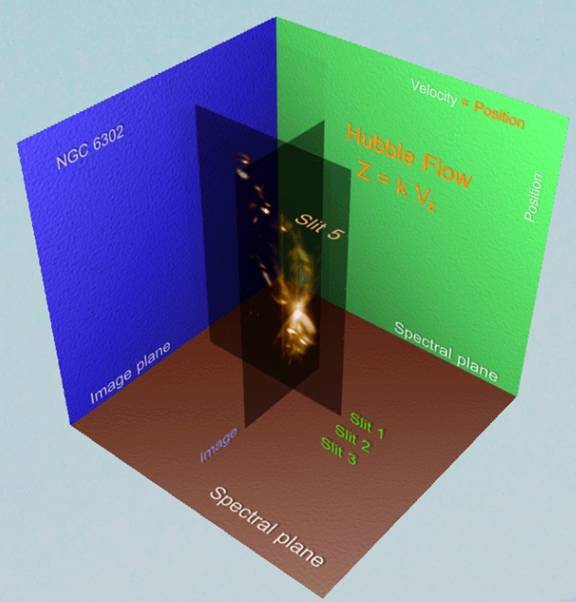
Figura 3: El hecho que la velocidad del gas en muchas nebulosas es una función de la posición permite la recontrucción de su estructura tridimensional a partir de imágenes e información espectral. En esta figura se ilustra esta idea en base a observaciones reales de la nebulosa planetaria NGC 6302.
Suscribirse a:
Entradas (Atom)